
Understanding your commercial and industrial electricity bill
A C&I bill is a stack of separate charges: some based on how much you use, some on when, some regardless of usage. Understanding which respond to timing is the first step to an energy management case.
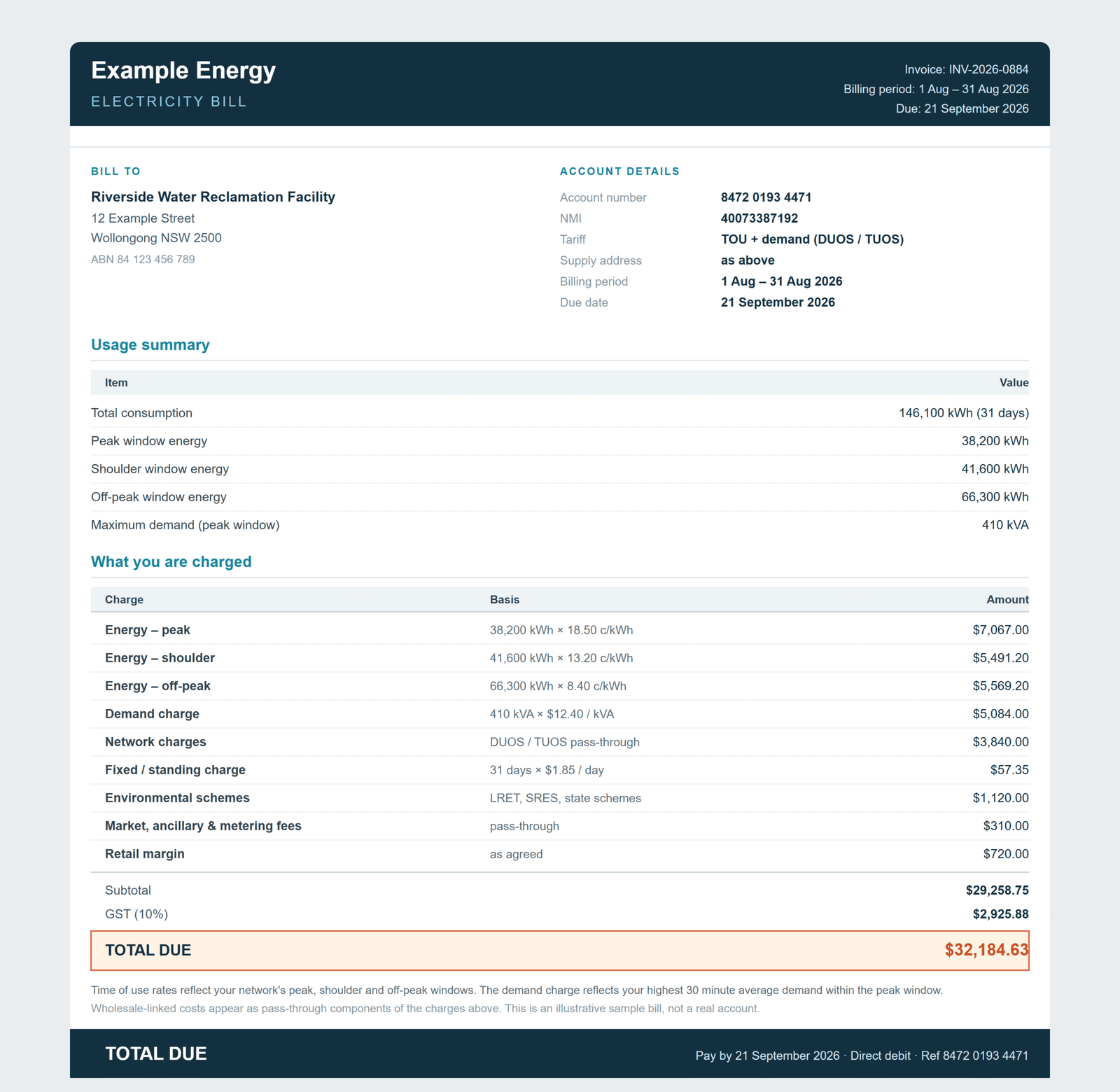
The building blocks of a C&I bill
Energy / volume charges
Cents per kWh. Flat, TOU (peak/shoulder/off-peak) or passed through from wholesale. Usually the largest component and the most responsive to load shifting. This is where Tariff Optimisation finds value.
Demand charges
Based on highest average demand (kW/kVA) over an interval (often 30 min) each billing period. A single peak sets the charge for the month. Flattening it saves independent of energy price. Explained →
Time-of-use tariffs
Rates that vary by when you use power, applied to energy or demand. Direct incentive to shift flexible load into cheaper periods without spot exposure.
Network charges (DUOS/TUOS)
Regulated charges for poles, wires and substations. For larger sites often demand-based rather than energy-based.
Fixed / standing charges
Daily charge regardless of usage. Does not respond to load shifting. Cost of being connected.
Loss factors
Adjustment for transport losses (DLF/TLF) by location. For spot-exposed sites, applied to the wholesale price to get the settled cost.
Environmental & scheme charges
Renewable and scheme obligations passed through on consumption. Not responsive to timing.
Ancillary, market & retail
Ancillary services, metering, AEMO fees and retailer margin. Retail margin is where a flat tariff and spot pass-through diverge most. The flat rate includes compensation for carrying volatility risk.
Why this matters for energy management
Fixed charges, ancillary services, scheme charges and market fees are largely unaffected by when you run. The charges that move with timing are: the energy charge (where it is TOU or spot-exposed) and the demand charge (where peak draw drives network cost). Identifying which parts of your bill actually move is what we do before building a simulation. See How We Work.
Where to from here
What is load shifting →: how timing creates value. Applied to a WWTP →