
Understanding the National Electricity Market
Every business in QLD, NSW, VIC, SA or TAS ultimately buys electricity that was traded through the NEM. Most never see it directly. Their retailer buys from the NEM and sells to them under a tariff. The NEM is where the underlying price is set.
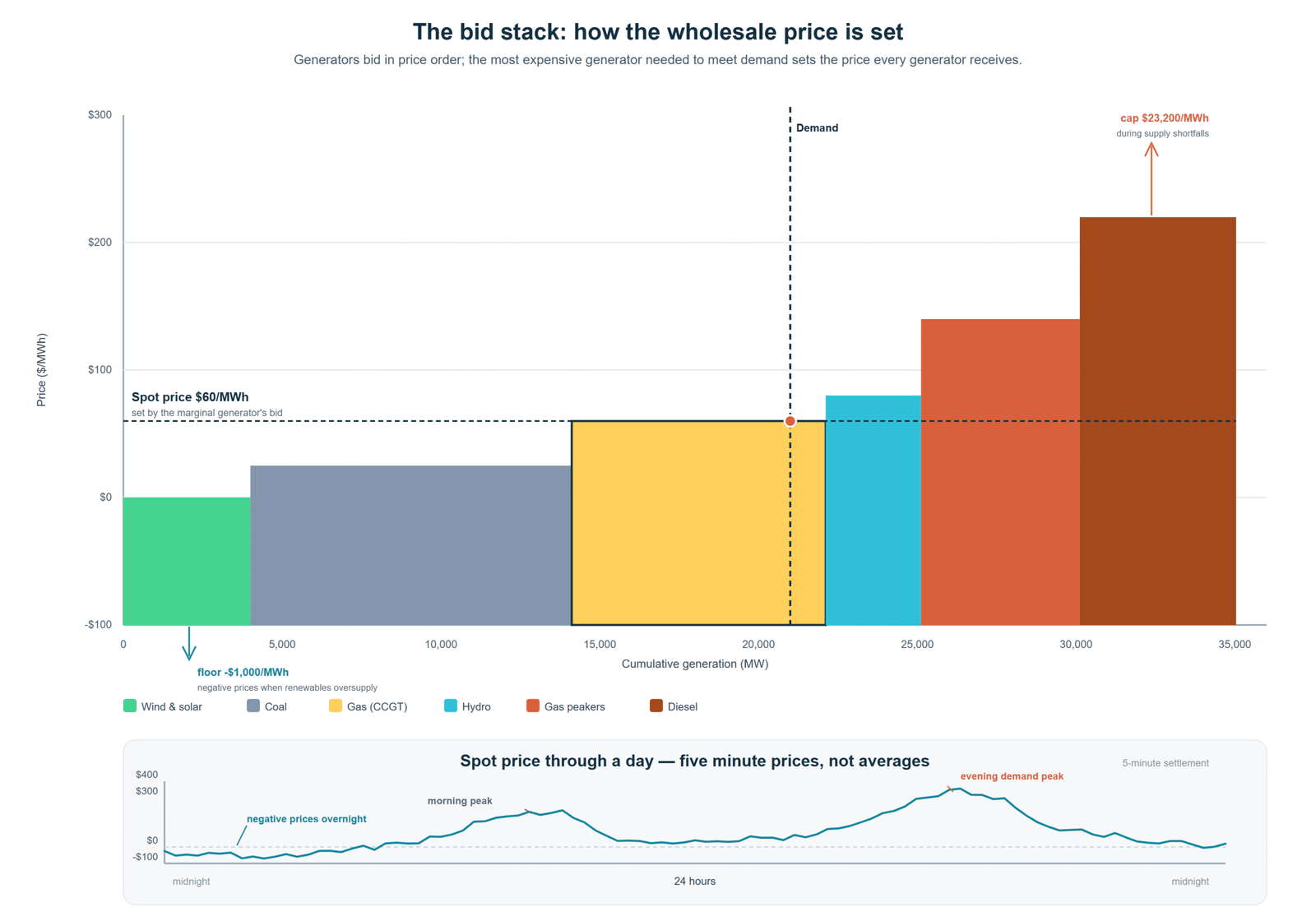
How the market sets a price
Every generator bids how much it will supply at a given price for every five-minute interval. AEMO stacks bids cheapest to most expensive and dispatches in that order until demand is met. The price paid to every dispatched generator, and effectively to everyone drawing from the grid, is set by the most expensive generator needed at that moment.
When demand is low and cheap generation (wind, solar, baseload) covers it, the price is low. When demand rises or cheap generation drops away, more expensive generators are called and the price rises to that next bid.
Five-minute settlement
The NEM settles on the interval it dispatches: every five minutes. This replaced the prior 30-minute average, which smoothed real volatility. A simulation built on actual 5-minute settlement captures the spikes and troughs that move within any half-hour, where much of the value sits. A generic estimate on averaged pricing understates it.
Price limits and negative pricing
The market operates between a floor and a cap set each financial year: down to -$1.00/kWh (credited to draw) and up to the market price cap, currently $23.20/kWh. Negative prices occur when renewables are abundant and inflexible baseload cannot reduce fast enough. Price spikes occur on extreme demand or constrained supply. Both ends benefit a site with genuine flexibility, but only if that flexibility is quantified against real data.
Regions and interconnectors
The NEM has five regions, QLD, NSW, VIC, SA, TAS, each with its own reference price, linked by interconnectors. When a region is short, cheaper power flows in from neighbours. Once the interconnector congests, regions decouple and sharp regional spikes occur. Your site’s region determines the volatility you see.
Where to from here
Electricity Tariffs Explained →: how these wholesale movements translate to your bill. What is load shifting →: how volatility becomes a business decision.