
What is load shifting, and when does it pay?
Electricity does not have one price. Load shifting is the practice of changing when you use electricity, in response to a TOU tariff, a demand charge window, or the wholesale spot price, rather than running to a fixed schedule regardless of price.
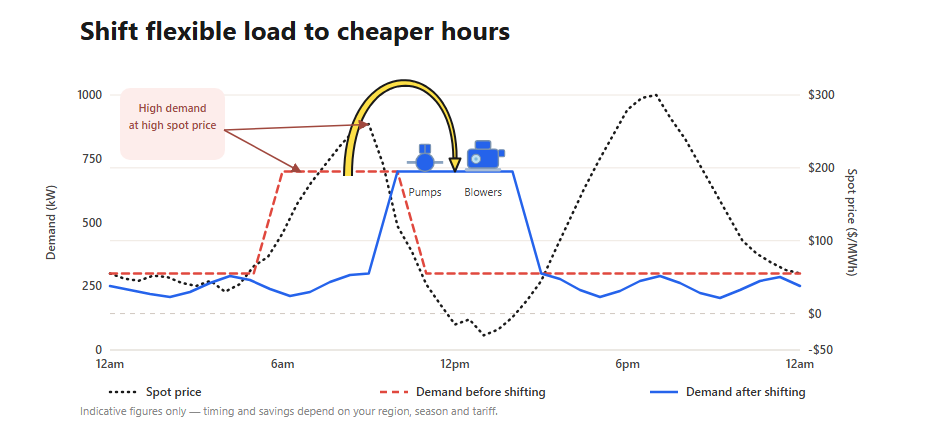
Why timing matters
Most businesses pay a retail tariff, flat or time-of-use, and never see the wholesale price underneath. But that tariff is ultimately funded from the NEM, where the price is set every five minutes. How the NEM works →
Three price signals can make timing valuable:
- Time-of-use (TOU) rates: peak/shoulder/off-peak pricing on your bill. Shifting into shoulder/off-peak is often the largest low-risk saving.
- Maximum demand charge: a few peak intervals set the network charge for the whole month. Flattening peaks saves independent of any energy price. Why it matters →
- Wholesale spot price: the 5-minute price, which can move from negative to the cap within a day. This is Route 03 only, and carries spot exposure. The volatility is shaped by renewables, coal retirement, batteries and electrification. The balance keeps shifting, but usable volatility remains.
What load shifting actually means
- Load shifting: moving flexible, non-time-critical use (pumping, batch processes, refrigeration) to cheaper periods.
- Peak avoidance: actively reducing demand during known expensive periods.
- Generation and storage dispatch: using solar, batteries or gas/biogas engines strategically rather than on a fixed schedule.
- Formal demand response programs: AEMO mechanisms providing grid capacity for payment. Separate consideration for larger, highly flexible loads.
What makes a site a good candidate
- Electricity-intensive processes with genuine timing flexibility: storage buffers, batch holdings or schedule headroom
- Existing or planned generation/storage that could be dispatched against price
- A large enough bill that a modest percentage saving is material
Whether spot exposure is needed depends on the route. Tariff Optimisation captures value without it; Alternate Tariffs captures it under a new structure; only Demand Response requires wholesale exposure.
Where to from here
Applied to a treatment plant
How pumping, blower control and biogas dispatch translate to real WWTP assets.
See a sample simulation
A full-year replay against real prices: the same output you would receive for your plant.