Understanding the National Electricity Market
Every business connected to the grid in Queensland, New South Wales, Victoria, South Australia, or Tasmania is ultimately buying electricity that was bought and sold through the National Electricity Market, or NEM. Most businesses never see this directly. Their retailer buys from the NEM and sells to them under a tariff. But the NEM is where the underlying price is actually set, and understanding how that happens is the foundation for understanding both your tariff and any demand response opportunity.
How the market sets a price
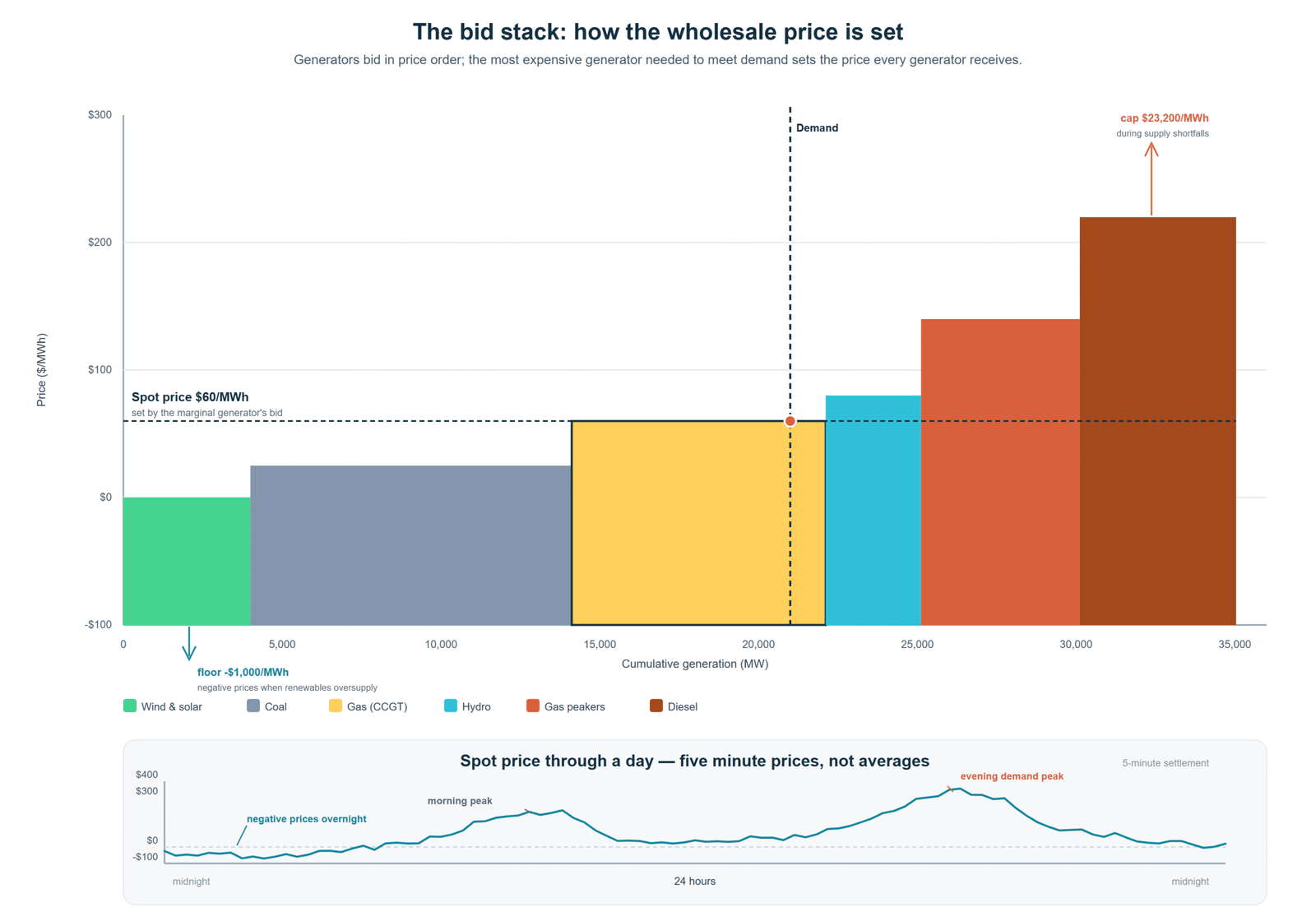
Generators do not simply supply electricity and get paid a fixed rate. Every generator in the NEM submits a bid for how much electricity it is willing to supply at a given price, for every five minute interval of every day. The market operator, AEMO, stacks these bids from cheapest to most expensive and dispatches generators in that order until enough electricity is being supplied to meet demand at that moment. The price paid to every generator dispatched in that interval, and the price everyone drawing from the grid effectively pays, is set by the most expensive generator needed to meet demand at that moment.
This is why the price moves constantly. When demand is low and cheap generation, wind, solar, and baseload coal, is enough to cover it, the price is low. When demand rises, or cheap generation drops away, more expensive generators are needed to fill the gap, and the price rises to whatever that next generator bid.
Five minute settlement
The NEM now settles on the same five minute interval it dispatches on. Every five minutes has its own price, calculated from that interval’s bidding and dispatch outcome. This replaced the previous arrangement where six five minute dispatch prices were averaged into a single thirty minute settlement price, which smoothed out a lot of the volatility that actually exists in the underlying market.
This matters directly for demand response. A generic estimate built on averaged or indicative pricing understates the real volatility available to respond to. A simulation built on actual five minute settlement data captures the price spikes and troughs that genuinely move within any given half hour, which is where most of the real opportunity sits.
Price limits and negative pricing
The market operates between a floor and a cap set by the regulator each financial year. Prices can fall as low as negative $1.00 per kilowatt hour, meaning a business drawing electricity during that interval is credited rather than charged, and can rise as high as the market price cap, currently $23.20 per kilowatt hour, during genuine supply shortfalls. Negative prices typically occur when renewable generation is abundant and inflexible baseload generation cannot reduce output fast enough to match falling demand. Price spikes typically occur during extreme demand, usually hot afternoons and evenings, or when generation capacity is constrained.
Both ends of this range represent an opportunity for a site with genuine flexibility. Using more electricity when the price is low or negative, and using less, or generating your own, when the price spikes, is the entire basis of demand response.
Regions and interconnectors
The NEM is divided into five regions, Queensland, New South Wales, Victoria, South Australia, and Tasmania, each with its own regional reference price. These regions are connected by interconnectors, transmission links that allow electricity to flow between regions when it is economic to do so. When a region has a shortage, the interconnector allows cheaper electricity to flow in from a neighbouring region, which is usually enough to prevent a local shortage from becoming a local price spike, provided the interconnector has capacity available. When it does not, the regions can decouple and price independently, which is often when the sharpest regional price spikes occur.
Your site’s price exposure is set by the region you are physically connected in, which is why two otherwise identical plants in different states can see quite different volatility and quite different demand response value.
How this connects to your bill and your options
Your retailer buys from this market and sells to you under a tariff, either a flat or time of use rate that insulates you from this volatility in exchange for a margin, or a pass through arrangement that exposes you to it directly. Which of these makes sense, and what a demand response strategy is actually worth, depends on understanding both sides. What the market is doing underneath your bill, and what your tariff structure is doing to shield or expose you from it.
Where to from here
For how these wholesale price movements translate into charges on your actual bill, see Electricity Tariffs Explained.
Read: Electricity Tariffs Explained ->
For how this volatility becomes a genuine business opportunity rather than just background market mechanics, see Demand Response Explained.