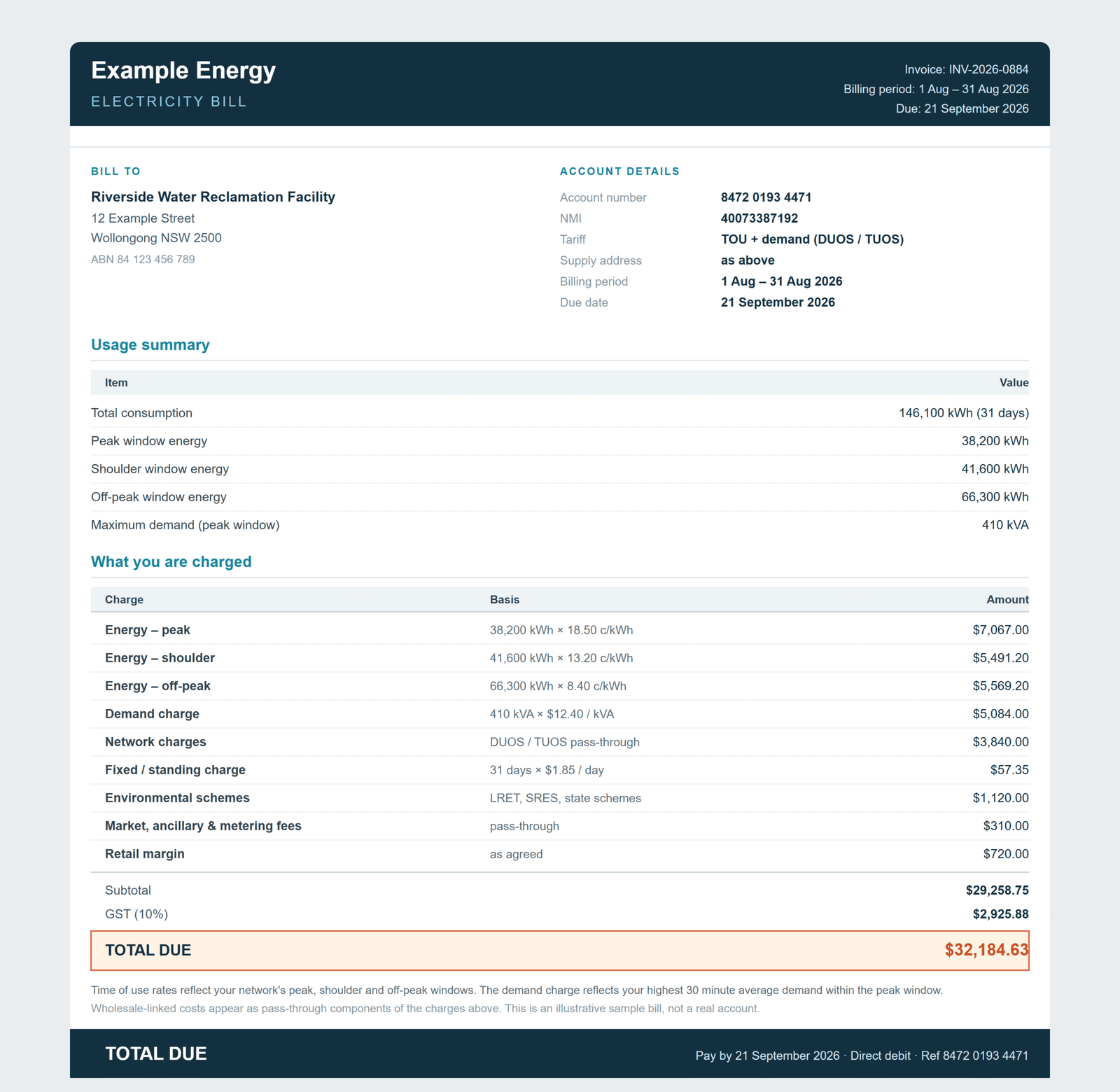
Understanding Your Commercial and Industrial Electricity Bill
A commercial or industrial electricity bill is rarely just a rate multiplied by usage. It is a stack of separate charges, some based on how much energy you use, some based on when you use it, and some you pay regardless of usage at all. Understanding what each of these charges actually represents is the starting point for working out which of them you can influence, and which are simply a cost of being connected to the grid.
The building blocks of a C&I electricity bill
Energy or volume charges
This is the charge most people think of as “the electricity price,” a rate in cents per kilowatt hour applied to how much energy you actually consume. On a simple tariff this is a single flat rate. On more sophisticated tariffs it varies by time of day, or is passed through directly from the wholesale market. This is usually the largest single component of a C&I bill, and the one with the most potential to be managed through load shifting.
Fixed or standing charges
A daily charge that applies regardless of how much electricity you use, covering the retailer’s cost of servicing the connection. This charge does not respond to demand response or load shifting, it is a fixed cost of being connected.
Network charges
Charges levied by the distribution network business (Distribution Use of System, or DUOS) and, for larger sites connected closer to the transmission grid, the transmission network business (Transmission Use of System, or TUOS). These charges recover the cost of building and maintaining the poles, wires, and substations that deliver electricity to your site, and are regulated rather than set competitively. Network charges are often the second largest component of a C&I bill after energy, and for larger sites are frequently structured around demand rather than energy consumed.
Demand charges
Rather than charging for total energy used, a demand charge is based on your site’s peak rate of electricity draw, typically your highest average demand in kilowatts or kilovolt amps over a defined interval, such as 30 minutes, during a billing period. Some demand charges apply across the whole day, others only during defined peak windows. A small number of demand tariffs use a ratchet structure, where a peak set in one month sets a minimum charge for months afterward, even if demand falls. Because demand charges are driven by your single highest peak rather than total consumption, a site with genuinely flexible load can often achieve a meaningful saving simply by flattening that peak, independent of any electricity price signal.
Time of use tariffs
A tariff structure, applied to either energy or demand charges, where the rate depends on when electricity is used, typically split into peak, shoulder, and off peak periods, with peak periods priced highest to reflect when the network and generation system are under the most strain. Time of use tariffs give a business a direct incentive to shift flexible load into cheaper periods, without necessarily being exposed to full wholesale price volatility.
Metering charges
A charge for the provision, reading, and maintenance of your electricity meter, and for larger interval metered sites, for the data services associated with retrieving usage data at five minute or thirty minute resolution. Usually a small component of the bill but a necessary one, and the meter type installed at a site determines what tariff structures are even available to it.
Ancillary services charges
A pass through charge covering the cost AEMO incurs keeping the power system stable, frequency control, system restart services, and similar functions that operate in the background of the grid regardless of any individual customer’s usage pattern. This is a market wide cost recovered from all participants and is not something an individual site’s load shifting behaviour materially changes.
Environmental and scheme charges
Charges that recover the cost of federal and state renewable energy and energy efficiency schemes, including the Large Scale Renewable Energy Target, the Small Scale Renewable Energy Scheme, and various state based schemes. These are policy driven costs, set by scheme obligations rather than market pricing, and are typically passed through to customers based on their electricity consumption regardless of when that consumption occurs.
Loss factors
Not a separate line item, but an adjustment applied to wholesale energy costs to account for the electricity lost as heat in transporting power from the generator to your site. Distribution Loss Factors (DLF) and Transmission Loss Factors (TLF) vary by location and connection point, and for a site with spot price exposure, these loss factors are applied to the wholesale spot price to determine the actual settled cost, meaning two sites paying “the same” spot price can end up with a different effective cost depending on where they sit on the network.
Market and participant fees
Smaller charges covering AEMO’s cost of administering the wholesale electricity market itself, again a pass through cost applied broadly rather than something specific to any one site’s behaviour.
Retail margin
The retailer’s own margin for the service of billing, customer support, risk management, and, where relevant, absorbing the risk of wholesale price volatility on your behalf. This is where a fixed or capped retail tariff and a direct spot price passthrough arrangement diverge most, a flat tariff has the retailer’s margin built in partly as compensation for carrying that volatility risk for you.
Why this matters for demand response
Not every charge on your bill responds to when you use electricity. Fixed charges, ancillary services, environmental scheme charges, and market fees are largely unaffected by load shifting, they are a cost of being connected and participating in the market at all. The charges that respond to timing and load shape are the energy or volume charge where it is time of use or spot exposed, and the demand charge where your site’s peak usage drives a meaningful part of the network cost.
Understanding which parts of your bill actually move in response to when and how much you use electricity is the first step in working out whether demand response is worth pursuing at your site, and it is usually the first thing I look at before building a simulation of what a control scheme could actually be worth.
Where to from here
If you want to understand how these tariff structures interact with real wholesale price volatility to create a demand response opportunity, I have written a general explainer on that next.
Read: What Is Demand Response, and Why Does It Matter? ->
If you operate a wastewater treatment plant and want to know what your own bill and plant flexibility could be worth, get in touch.