What Is Demand Response, and Why Does It Matter?
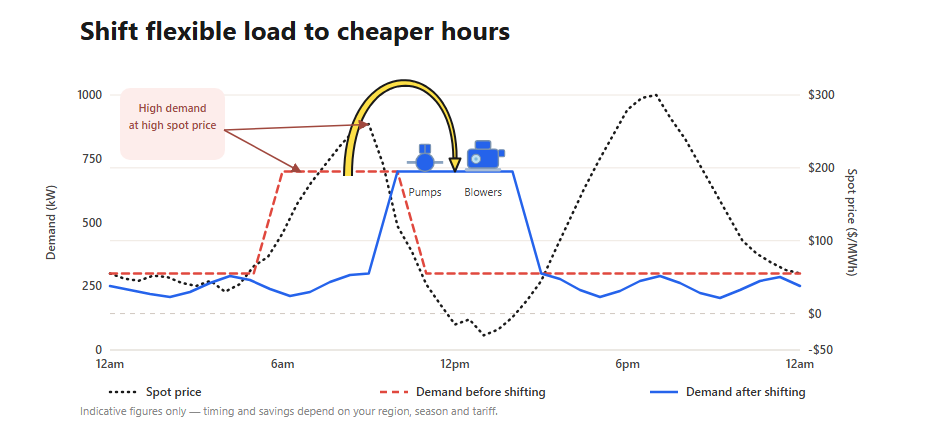
In Australia’s National Electricity Market, the wholesale price changes every five minutes, and can move from -$1000 per megawatt hour (-$1.00/kWh) to the market price cap, currently $23,200 per megawatt hour ($23.20/kWh), within the same day. Demand response is the practice of shifting how much electricity your business uses to take advantage of that volatility.
Why electricity prices move so much
Most businesses pay a retail tariff, a flat or time of use rate set by their electricity retailer, and never see the wholesale price underneath it. But the retailer is buying that electricity from the National Electricity Market (NEM), where the price is set every five minutes by matching generation supply against demand across the grid.
When demand is high, or when low cost generation like wind and solar is scarce, the price rises sharply. When demand is low and renewable generation is abundant, the price can fall to zero, or even go negative, meaning a business using electricity during that period is paid a credit rather than a charge. This volatility is shaped by two opposing forces. More variable renewable generation entering the grid, and the retirement of coal fired baseload capacity, tends to increase price swings. Growing battery storage capacity across the grid works the other way, smoothing volatility by charging during low price periods and discharging during high price periods. The balance between these two forces will keep shifting over time, but for now there remains real volatility for a business to respond to. For a business willing to shift load around it, that volatility is an opportunity. For a business locked into fixed consumption patterns, it is a cost that is largely out of their control.
What demand response actually means
At its simplest, demand response means changing your electricity consumption in response to a signal, usually price, rather than running on a fixed schedule regardless of what electricity costs at the time.
This can take a few forms:
- Load shifting. Moving flexible, non time critical electricity use, pumping, batch processes, refrigeration, compressed air, to periods when wholesale prices are lower, and reducing use during price spikes.
- Peak avoidance. Actively reducing demand during known high price periods, rather than shifting the load elsewhere, where the load is genuinely deferrable or reducible.
- Generation and storage dispatch. Where a site has its own generation, solar PV, batteries, gas or biogas fired generators, using it strategically, storing energy when the price is low, and generating or discharging when the price is high, rather than running it on a fixed schedule.
- Formal demand response programs. Some businesses can also participate in AEMO administered mechanisms directly, providing capacity to the grid in exchange for payment. These formal programs suit larger, highly flexible loads and are a separate consideration to the load shifting described above, which most industrial sites can pursue independently regardless of their size.
What makes a site a good candidate
Not every business benefits equally from demand response. Sites tend to be good candidates when they have some combination of the following:
- Electricity intensive processes with genuine flexibility in timing, storage buffers, batch processes, or holding capacity that allow operation to shift without affecting output or service
- Existing or planned on site generation or storage, solar PV, batteries, or fuel fired generation, that could be dispatched against price rather than run on a fixed schedule
- Exposure, or the ability to negotiate exposure, to wholesale or semi wholesale electricity pricing, rather than being locked into a flat retail rate that removes any incentive to shift load
- A large enough electricity spend that even a modest percentage saving is material in dollar terms
The part most businesses get wrong
The physical flexibility to shift load usually already exists, most industrial sites have some buffer, storage, or schedule flexibility somewhere in their process. What is usually missing is the answer to a much harder question, what is that flexibility actually worth against real price volatility, and is it worth the cost and risk of building a control system to capture it.
That question needs to be answered against real operating constraints, not just the theoretical price opportunity. Some equipment cannot be started and stopped frequently without accelerating wear, so a control scheme has to respect realistic duty cycles, not chase every price movement. And any change to how a plant is operated needs to be checked against the process itself, a control scheme that saves money on electricity but destabilises a treatment process, a batch operation, or a product quality outcome is not a saving at all. This is exactly why the assessment needs to be done through a proper simulation of the actual plant and its constraints, not a simplified estimate that ignores them.
Generic estimates and industry rules of thumb tend to either overstate the opportunity, because they assume perfect dispatch against every price spike with no regard for equipment or process limits, or understate it, because they average prices over a period and miss the volatility that is where the real value sits. A credible business case needs a simulation of your actual assets against real five minute market price data, not an average, showing what a properly controlled system would actually have earned or saved over a real period, under realistic operating and process constraints.
That is the starting point for any demand response investment decision, and it is the same starting point regardless of industry, whether the flexible load is a compressor, a cold store, or a wastewater treatment plant.
Where to from here
If you operate a wastewater treatment plant, I have written specifically about how these principles apply to pump control, blower control, and biogas cogeneration.
See how this applies to wastewater treatment plants ->
If your business operates a different kind of flexible load and you want to understand what it might be worth, get in touch and I can talk through whether a feasibility study makes sense for your site.